Corson County Dog Registration Information
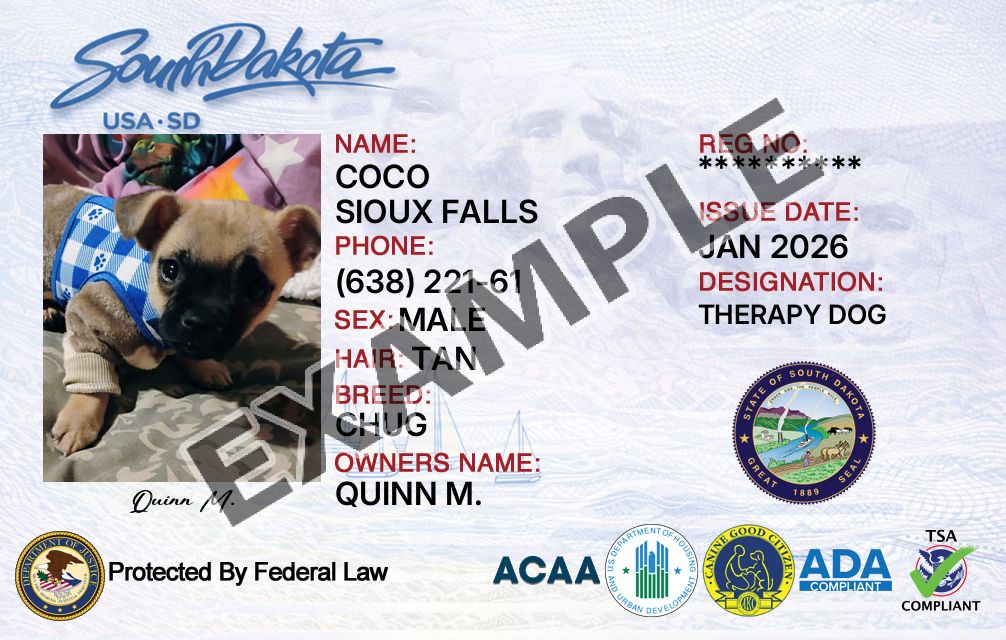
Service Dogs and Emotional Support Animals in Corson, South Dakota
If you’re asking, “where do I register my dog in Corson County, South Dakota for my service dog or emotional support dog,” the answer usually starts with the same local process as any other pet: many areas require a dog license in Corson County, South Dakota (or within the city limits where you live), often tied to proof of rabies vaccination. Service dogs and emotional support animals (ESAs) are handled differently under the law, but that difference typically affects access rights and housing rules—not whether your dog must follow local licensing, vaccination, and at-large rules.
Where to Register or License Your Dog in Corson County, South Dakota
Based on available official county contact information, the following county offices are the most practical starting points for questions about where to register a dog in Corson County, South Dakota, local ordinances, and animal control enforcement. Because licensing rules can be set by a city/municipality and enforcement may involve law enforcement, calling ahead is recommended to confirm the correct office for your specific address.
Corson County Treasurer
- Monday–Thursday: 7:30am–5:00pm Mountain Time (closed noon–12:30pm)
- Monday–Thursday: 8:30am–6:00pm Central Time (closed 1:00pm–1:30pm)
- Friday: 7:30am–11:30am Mountain Time
- Friday: 8:30am–12:30pm Central Time
Corson County Sheriff’s Office (Animal Control / Enforcement Questions)
Corson County Auditor (General County Administration / Referrals)
- Monday–Thursday: 7:30am–5:00pm Mountain Time (closed noon–12:30pm)
- Monday–Thursday: 8:30am–6:00pm Central Time (closed 1:00pm–1:30pm)
- Friday: 7:30am–11:30am Mountain Time
- Friday: 8:30am–12:30pm Central Time
Overview of Dog Licensing in Corson County, South Dakota
What “dog registration” usually means locally
In most South Dakota communities, “registering” a dog refers to obtaining an annual (or periodic) dog license and, in some places, a tag number tied to the owner and the dog’s rabies vaccination status. Requirements and fees are commonly set by local ordinance and can differ by municipality. That means the exact process for a dog license in Corson County, South Dakota may depend on whether your home is:
- Inside a city or town boundary (city ordinances and city licensing processes may apply).
- In unincorporated areas of Corson County (county-level rules and enforcement may apply).
- On tribal land (tribal rules and processes may apply; requirements can differ from county or city processes).
Common goals of licensing and animal control rules
Local licensing and animal control rules are typically intended to support public health and safety, including rabies control, reuniting lost pets with owners, and providing a structured way to address nuisance or at-large situations. Even if your dog is a service animal or emotional support animal, local public health requirements (like rabies vaccination where required) may still apply.
What You Need Before Registering a Dog
Documents and details to gather
When you contact the appropriate office about where to register a dog in Corson County, South Dakota, have these items ready, because they are commonly requested for licensing in many communities:
- Rabies vaccination certificate showing the veterinarian, vaccination date, and expiration date.
- Owner identification (such as a driver’s license or other photo ID).
- Proof of residency/address (especially if the licensing office needs to confirm city limits vs. county jurisdiction).
- Spay/neuter documentation (if applicable and if licensing fees differ by altered status).
- Dog details: name, breed (if known), color/markings, age, sex, and microchip number (if any).
Service dog or ESA paperwork: what matters (and what doesn’t)
If your dog is a service dog or emotional support animal, licensing staff may still ask for standard licensing items like rabies vaccination. However, service dog or ESA “registration” does not work like a government-issued license. Instead:
- Service dog status depends on disability-related training to perform tasks (not a registry number).
- ESA status is generally relevant in housing contexts and typically relies on documentation from a qualified healthcare provider (not a public-access credential).
Steps to Register or License a Dog in Corson County, South Dakota
Step 1: Confirm which rules apply to your address
Start by confirming whether your residence is within a municipality, in the unincorporated county area, or on tribal land. This is the most important step for pinpointing the right process for dog licensing requirements Corson County, South Dakota.
Step 2: Call the appropriate office to confirm requirements and fees
Use the “Where to Register or License Your Dog in Corson County, South Dakota” section above to contact the county offices. Ask:
- Is a dog license required at my address?
- Is licensing handled by the county, my city/town office, or another local authority?
- What documents do you require (rabies certificate, ID, proof of residency, spay/neuter proof)?
- What are the current fees and renewal period?
- How do I submit paperwork (in person, by mail, or other local process)?
Step 3: Submit paperwork and keep your records current
Once you confirm the correct licensing office and requirements, submit your documents and payment (if applicable). Keep copies of vaccination certificates and any receipt or tag information. If you move to a different part of the county or into/out of city limits, re-check which rules apply.
Step 4: Understand how licensing relates to service dogs and ESAs
Local licensing is mainly about identification and public health. It does not grant service dog public access rights, and it does not establish ESA housing eligibility by itself. Think of licensing as the local “pet ownership” requirement that may apply regardless of your dog’s role.
| Category | What it is | What it’s for | Common documentation |
|---|---|---|---|
| Dog license | Local license/registration required by some counties/cities for dogs kept in the area. | Public health (often rabies compliance), identification, local animal control administration. |
|
| Service dog | A dog individually trained to do work or perform tasks for a person with a disability. | Public access rights in many settings when accompanying the handler; disability-related assistance. |
|
| Emotional support animal (ESA) | An animal that provides comfort/support that helps with a disability-related condition (generally relevant to housing). | Housing-related accommodations in some circumstances; not the same as public access rights. |
|
Service Dog Laws in Corson County, South Dakota
Service dog status is not created by local licensing
A service dog’s legal status comes from what the dog is trained to do for a person with a disability, not from a county-issued “service dog registration.” In other words, the county or city dog license (if required) is separate from service dog public access rights.
What you can expect locally
- Licensing and vaccination rules may still apply to service dogs, depending on local ordinance.
- Behavior standards still matter: service dogs are generally expected to be under control.
- Enforcement questions (e.g., dogs at large, bites, nuisance issues) are typically handled through local law enforcement/animal control processes.
Practical tip when calling about a service dog
When you contact the office listed above, you can ask two separate questions to get clear answers:
- “Do I need a dog license at my address in Corson County, and what documents/fees apply?”
- “If a license is required, is there any local exemption or special handling for trained service dogs?”
Emotional Support Animal Rules in Corson County, South Dakota
ESAs are not the same as service dogs
Emotional support animals can be important for a person’s disability-related needs, but ESA status does not automatically provide the same public access rights as a service dog. Most ESA discussions come up in housing contexts. Separately, local dog licensing (if required) is usually about rabies vaccination and local ordinance compliance—regardless of ESA status.
How to approach local licensing if your dog is an ESA
- Ask the licensing office what is required for all dogs in your jurisdiction (rabies certificate, proof of address, fees).
- Keep your dog’s vaccination records current, since licensing commonly depends on rabies documentation.
- If you need housing-related accommodations, be prepared to follow the housing provider’s process (which is typically separate from county/city licensing).
Frequently Asked Questions
Is there one official registry for service dogs or emotional support animals?
No. There is no single universal federal government registry that you must use to “register” a service dog or emotional support animal. Local dog licensing, if required where you live, is a separate process from service dog legal status or ESA housing documentation.
Do I need a rabies certificate to get a dog license in Corson County, South Dakota?
Many local licensing systems require proof of rabies vaccination. Requirements can differ by city or jurisdiction within the county, so call the appropriate office to confirm exactly what is needed for your address.
Which office should I call first if I’m not sure where to license my dog?
Start with the Corson County Treasurer for licensing-related direction, especially if you’re unsure whether the county or your municipality handles licensing. For animal control enforcement questions (at-large issues, public safety concerns), the Corson County Sheriff’s Office is a key contact.
If I live inside city limits, can city rules differ from county rules?
Yes. Municipal ordinances can differ from county-level rules, including licensing requirements, fees, and tag processes. This is why confirming your address jurisdiction is a key first step when asking about an animal control dog license in Corson County, South Dakota.
Do service dogs or ESAs get “registered” at the Sheriff’s Office?
Typically, no. The Sheriff’s Office is a primary contact for enforcement and public safety matters. If local licensing is required, the licensing process is usually handled through a licensing or administrative office (and may be managed by a county or city office depending on where you live).
Register A Dog In Other South Dakota Counties
Select your county below to get started with your dog’s ID card. Requirements and license designs may vary by county, so choose your location to see the correct options and complete your pup’s registration.
- Aurora County Dog Registration
- Beadle County Dog Registration
- Bennett County Dog Registration
- Bon Homme County Dog Registration
- Brookings County Dog Registration
- Brown County Dog Registration
- Brule County Dog Registration
- Buffalo County Dog Registration
- Butte County Dog Registration
- Campbell County Dog Registration
- Charles Mix County Dog Registration
- Clark County Dog Registration
- Clay County Dog Registration
- Codington County Dog Registration
- Custer County Dog Registration
- Davison County Dog Registration
- Day County Dog Registration
- Deuel County Dog Registration
- Dewey County Dog Registration
- Douglas County Dog Registration
- Edmunds County Dog Registration
- Fall River County Dog Registration
- Faulk County Dog Registration
- Grant County Dog Registration
- Gregory County Dog Registration
- Haakon County Dog Registration
- Hamlin County Dog Registration
- Hand County Dog Registration
- Hanson County Dog Registration
- Harding County Dog Registration
- Hughes County Dog Registration
- Hutchinson County Dog Registration
- Hyde County Dog Registration
- Jackson County Dog Registration
- Jerauld County Dog Registration
- Jones County Dog Registration
- Kingsbury County Dog Registration
- Lake County Dog Registration
- Lawrence County Dog Registration
- Lincoln County Dog Registration
- Lyman County Dog Registration
- Marshall County Dog Registration
- McCook County Dog Registration
- McPherson County Dog Registration
- Meade County Dog Registration
- Mellette County Dog Registration
- Miner County Dog Registration
- Minnehaha County Dog Registration
- Moody County Dog Registration
- Oglala Lakota County Dog Registration
- Pennington County Dog Registration
- Perkins County Dog Registration
- Potter County Dog Registration
- Roberts County Dog Registration
- Sanborn County Dog Registration
- Spink County Dog Registration
- Stanley County Dog Registration
- Sully County Dog Registration
- Todd County Dog Registration
- Tripp County Dog Registration
- Turner County Dog Registration
- Union County Dog Registration
- Walworth County Dog Registration
- Yankton County Dog Registration
- Ziebach County Dog Registration